
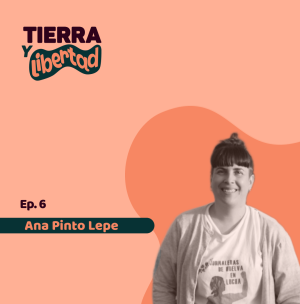
In this episode, we welcome Ana Pinto Lepe, a Spanish activist from Andalusia. Ana is co-founder of the collective Jornaleras de Huelva en Lucha, which defends labor and human rights in the fields through union action, legal support and awareness-raising. Her feminist, anti-racist fight for the rights of farm laborers is a genuine inspiration, and she has documented her work in the book "Abramos las Cancelas," co-written with her comrade Nazaret Castro.
Hi Ana, thank you for accepting this invitation, and welcome to the Tierra y Libertad podcast. To start, could you briefly introduce yourself to our listeners?
My name is Ana Pinto Lepe. I'm thirty-nine years old, and I come from Escacena del Campo, a small village of about two thousand people in Huelva. The best village that has ever existed on earth, I'm very proud of it. Within Jornaleras de Huelva en Lucha, we lead a struggle that tries to bring together the many issues we face in our region.
How did you get into farm work and strawberry production?
I started in the fields at sixteen. My whole family are farm laborers. Since childhood, I remember watching my parents come home from the fields and hearing them talk about what happens out there, and it was never pretty. That's how it is here: if you don't want to study, you go work in the fields. It's the most normal thing at that age. I spent sixteen years there in total.
Before we talk more about Jornaleras de Huelva en Lucha, could you give us some brief context on Huelva: what crops existed before, and how did strawberry farming develop?
When I was working in the fields, I knew nothing of this history. But the sociologists, anthropologists and other experts who have studied our province, whom we met through our struggles, explain to us that before, there were almost only dry-farmed crops here. We're in a Mediterranean climate: water is scarce and temperatures are very high, which is getting worse with climate change. We used to grow grapes. Neighbors, the grandfathers and grandmothers of my village, tell me there were also a lot of caper bushes, a crop we barely know here anymore today. Then there was a period with a lot of olive trees, until someone coming back from California saw how strawberry greenhouse farming worked over there. Since we have a very similar climate, with the same water problem, this model rode the boom of the so-called Green Revolution, which was called "green" but was the exact opposite.
This capitalist, neoliberal expansion of agriculture and food chains is presented as progress and a source of economic growth. But the reality is that food has been turned into a business, and a model imported from California has been implanted here: patented varieties, fertilizers, pesticides, berry monoculture. A model that not only exploits the people who work in it, but also grabs all our resources, our natural heritage, our water, pollutes them and exports them. As our comrade Nazaret puts it well in the book "Abramos las cancelas": every time we export a strawberry, we export our water. Everything is oriented toward agribusiness, and the abuses against workers, as well as the pollution this generates, are always covered up by the various governments.
And roughly when did this strawberry sector develop?
It started in the sixties. Back then, the people who came to work in the fields came from other villages in Andalusia, mainly from Cádiz and Jaén, and also from Extremadura, where job alternatives have always been scarce. In the early 2000s there was a shift: they started bringing in labor from Eastern Europe. I lived through that moment in the fields, I had just started, and I wondered where these women came from, arriving exhausted, having not slept, their bodies worn out. When we managed to communicate despite the language barrier, they told us they worked night shifts in the packing warehouses and then went to the fields during the day. I remember that back then we organized in teams to lend them a hand, we'd give them crates so they wouldn't fall too far behind.
Around 2006, according to official statements reported in various media outlets and studies carried out by the strawberry employers' association itself, they decided the Romanian women "liked partying too much," that they'd show up on Sundays hungover, and that they "stole the village women's husbands"; there's a fairly solid report on this by our comrade Alicia Reigada. They then decided that in Morocco's impoverished villages there were more submissive women who, "by their culture," didn't like alcohol or parties, and that they were preferable labor. In the end, the origin-contract quota filled up more and more with Moroccan comrades, even though Eastern European women kept coming too. In recent years, they've also extended origin contracts to Latin America, namely Guatemala, Honduras, Ecuador, Colombia and Paraguay, as well as to other African countries like Senegal and Mauritania.
Everything I'm telling you concerns origin contracts, which began in the 2000s. But you also have to take into account that part of the sector is made up of people in an irregular administrative situation, who survive with great difficulty in shantytowns built from the same plastic as the greenhouses, wooden pallets and strawberry-crate cardboard. The night before last, one of them burned down again, they're regularly ravaged by fires. These are people exploited from sunrise to sunset. There's a racist immigration law here that lets people stay in this country for three years without being able to regularize their status. During those three years, they form a pool of cheap labor: they're paid far less than people with papers, they're promised a contract after three years, which is a lie, and in the end they're fired without being able to prove they worked, for lack of papers. They're sold work contracts, or made to work for free on the promise of papers.
That's the pattern we're up against, always bearing in mind that, even though people from other provinces of Andalusia or from Extremadura no longer come, half of those working the fields of Huelva are still local people, from the villages. The other half is made up of comrades who came from elsewhere.
There's an important gender dimension to strawberry farming, where women are mostly employed. Can you explain why?
The employers' own reports say women have more delicate hands for picking a fragile crop. Beyond the sexist bias in those words, that's not all: very specific profiles of migrant women have been selected, because employers know that once here, it will be harder for them to protest. In the case of our Moroccan comrades, to come here you have to be a woman, be from rural areas rather than cities, and have at least one minor child or a dependent elderly relative. Not a single man comes. Why? To make sure they go back to their country at the end of the season and don't stay. It's the most absolute instrumentalization of people, and in this case of women, because to them they're only numbers, cheap labor. If someone told me that to go work in another country, I'd cry scandal and call that country sexist. And yet, this has been going on for twenty years and everyone thinks it's normal. Then they pin themselves with the medal of progressive, feminist, women-defending governments.
You yourself worked in the fields for sixteen years. How did working conditions change over that period?
I went through different eras. At the start, despite the hard work and the little we were paid, I'd go home only looking forward to one thing: for the next day to come so I could go back to the fields. I was a kid, a minor, all my colleagues were older, and the relationship we had was wonderful. They taught me a lot, not just how to work the fields, but also that resourcefulness you develop out there. There were always jokes and good spirits, to make the day go by faster, which has nothing to do with stopping work, because you can talk and move your hands at the same time.
Today we've reached the point where, from day one, you're made to sign a list of abusive rules. In some places it's forbidden to talk to coworkers about anything other than work, and we have a screenshot of one company's rules that proves it. Forbidden to listen to music, to wear an earbud or a radio, which people had always brought to the fields and which is now completely banned. We got to the point where between colleagues we'd say "back at Alcatraz again" or "back at Guantánamo again," some companies ended up being given prison names. I think that's a clear symptom of what's going on inside.
Was this shift in working conditions gradual, or do you trace it to a specific moment?
These are things they imposed on us little by little. At first, inspectors would come to check the state of the fruit, that you weren't wearing earrings or nail polish, that you weren't using your phone to listen to music, that you weren't wearing headphones. Then they inspected the fruit itself: "this fruit isn't good," "it's scratched," "you didn't remove the little fuzz on this blueberry." Three hours spent examining them. At the same time, the supervisor pushing all day, shouting: "come on, you've barely picked any kilos." Absolute pressure. And every year, new rules. At the company where I worked, they started with a few rules, and by the last year there was a huge stack of papers to sign.
What I told you earlier, that we used to help our Romanian comrades because they arrived exhausted from their night shift in the packing warehouse, that's changed: now in many places they've banned helping out colleagues so they don't fall behind in the sorting. There are women over sixty who've worn out their bodies and their backs in the fields and who don't have the same strength as a young person, and you're not allowed to help them. On top of that there's a productivity ranking. Everyone has a chip or a tablet, and everything you pick is sent in real time to an office, as if you were being tracked by GPS. At the end of the day they draw up a ranking from most to least productive, calculate the average, and highlight those below it, and they often post it somewhere visible to humiliate you, pressure you, pit you against the others. Field work has become a permanent competition.
Another rule: you can't bring water in your cart, so that not a single drop falls on the fruit that someone in Germany is going to eat. Meanwhile, whoever is picking under a greenhouse at close to sixty degrees has to leave their bottle at the entrance and think twice before going to get it because it costs them time. With heat waves becoming more and more frequent, staying hydrated is a vital necessity. Same for going to the bathroom: "I'm not going now because I'm losing time." And before you know it, it's one in the afternoon, you've drunk water twice and haven't been to the bathroom. I've seen colleagues get bladder infections from holding it in. It's a completely perverse system, built on absolute productivity.
Farm workers work under the Special Agricultural Regime. What does it involve, and what are its consequences for workers?
It's a regime almost nobody understands, created half a century ago and that no longer makes any sense today. It's a different regime from the general one, in which we farm workers are entirely without protection and at a disadvantage. To start, whoever is registered under this regime is a kind of fake self-employed worker: you're the one who pays your own social security contribution, not the company. And what happens? A rise in the minimum wage, like the one we had here, ends up penalizing field workers. Why? Because raising the minimum wage also raises, via the IPREM index, the "sello agrícola," the farm contribution. When I quit, we were paying under a hundred euros a month; now it's nearly two hundred.
To be able to claim any benefit at all, you also need what's called a "peonada," a real day's work. Normally you need 35, but in years with weather problems that number gets reduced, currently it's five. But you have to have them, on top of paying your contribution. Another major problem: under this regime, you can be registered with social security the whole month, but only the days actually worked get counted. In other words, you're registered all month and in the end you only have three real days. When field work is unstable, the fruit hasn't ripened, there's bad weather, the day you work you get paid, the day you don't work you don't. And you can't apply for a benefit if you didn't do it before you started working, because once you're registered you can't apply for it. It's a real headache.
And on top of that, if the season ends and you go work at a hotel by the beach, which falls under the general regime, you still have to keep paying the farm contribution if you want to later access your farm benefit. And the hotel pays your general-regime contributions on top of that. In other words, you're paying into two systems at once. It's a poverty trap for farm laborers, even though our work is essential so that everyone can eat.
Beyond the special agricultural regime and company rules, could you give us concrete examples of the most common abuses and mistreatment?
I've endured exploitation my whole life in the fields, and so have my mother, my family, my neighbors. I know how it works. But women who come from elsewhere face even harder circumstances. I understood this fully in 2018, when we started protesting and I'd been working for a while with a team of Moroccan comrades: that's when I realized we were already at a disadvantage, and that they were even more so. Because you have to take into account that they come from another country, that they've left their family, that they've given up everything to come here.
The main problem is the language barrier. Just the bureaucracy and the legal system here cost all of us dearly, I'm still learning even today, so imagine someone who doesn't speak the language. And if you suffer abuse, say because you ask to be taken to the doctor and they don't take you, because you fall ill and they send you straight back to Morocco, or because you picked fewer kilos and you get penalized, you're not with your family, you have no one around you. Women under origin contracts live where they work, far from urban centers, in pine groves in the middle of the greenhouses. They know neither the language nor their rights.
And if you're sent back to your country, whether it's Morocco or Colombia, that's where the real problem lies: how can a woman file a complaint from her own country over an unfair dismissal in Huelva? That's what they take advantage of. We've always heard the employers say: "if there's so much abuse, why don't they file complaints?" Because they can't. They don't file complaints because they have no access to legal recourse, and the employers know it and take advantage of it.
Can you tell us more about what drove you to create Jornaleras de Huelva en Lucha, and what results have you achieved as an organization?
This question always makes me smile, because the truth is it was built step by step. We were very angry. Wonderful people reached out to us and put their knowledge at our service, so we could learn, understand the situation, know our rights and what a union is. With their support, financial too, we launched a crowdfunding campaign that raised us 30,000 euros, thanks in particular to a Catalan pianist, Clara Peya, who made the song "Mujer Frontera" with Alba Flores and Ana Tijoux. They gave us enormous visibility.
After going through a few unions with bad experiences, we were finally able to work fully independently. Since then we've been here, gathering small private grants here and there to pay a fair wage to the three people who work here: María the translator, our comrade Tere, who's a lawyer, and me.
At the start it was very hard. We did this work ant-step by ant-step: outreach, political influence through social media, handing out flyers. Getting the word out that we're here and that workers have access to a free lawyer to file complaints. Once trust was established, we started organizing union sections. Last year, for the first time, we set up two: one with local comrades and another with comrades from Morocco. The union delegate was a Moroccan comrade under an origin contract. Something entirely unprecedented, and very powerful.
Unionizing in Huelva is very hard: people come and go, there's the language barrier, they live where they work. But little by little, workers are organizing themselves within the companies. That first union section won all of its demands: payment of the minimum wage and better housing conditions. All thanks to their organizing on the ground, with our support.
Another important result: we've managed to file transnational complaints from other countries against companies in Huelva. We've already filed several with comrades who stayed in Morocco, over unfair dismissals. This year we had our first trial over a transnational complaint, and we won. We didn't even need to go to trial: the company acknowledged the unfair dismissal and compensated the worker. For any other worker, that would be a normal thing. For us it's a huge turning point. Now, you can no longer fire someone, send them back to their country and forget about it. She now has the option of filing a complaint from there.
Finally, there's the title of our book, "Abramos las cancelas." As a union, we had no access to our comrades' housing, located inside private farms. Thanks to all the pressure we exerted, laws have finally been passed: they recognize that unions have the right to access this housing, even inside the farms. We managed to open the gates (cancelas). With just these three advances, all the effort and all the suffering of this struggle were worth it.
What are some of the tactics that have worked?
The top-priority tactic is finding ways around the legal system: how do we make sure our comrades can access it despite the language barrier, or the fact that they're no longer in the country once the season ends. All of that thanks to the remarkable work of our lawyer, Teresa Ramos Antuñano.
On the other side, there's pressure and direct union action. Social media has been very useful to us from the start for that, it's our main tool, and above all public denunciation. The media always interview companies: how many millions the sector generates, they praise how well origin contracts work. But they never talk about the workers, about how they're doing, about whether their rights are respected. Luckily, today some media outlets are interested in our side of the story. They publish the abuses we denounce, with the evidence we provide: audio recordings, photos, testimonies, complaints and responses from the Labor Inspectorate; that's our best tool.
The Labor Inspectorate has very limited resources: there were twelve or thirteen inspectors for the entire province of Huelva, across all economic sectors combined, while in March there can be over a hundred thousand workers in the fields alone. A real absurdity. And when it comes to formal complaints, the law is made for employers: not keeping a record of working hours is punished with a seven-hundred-euro fine. What does that mean for a berry multinational? Absolutely nothing. That's why public denunciation is what works best.
There's also the duty-of-vigilance law, which already existed in Germany and has since been adopted at the European level. It states that supermarkets selling a product proven to come from social or environmental exploitation can face a fine of several million euros. It helps us work even with the supermarkets themselves, when we know which one buys products from a company that exploits its workers.
And did you support that change in the law directly?
No, we weren't directly involved in that. But what the experts always tell us is that this kind of law was pushed forward thanks to all the struggle we've been carrying out for a long time, alongside other people, around what's happening in agriculture, and everything that has shifted and come out into the open.
Our comrades Estefanía Prandi and Pascal Müller presented an investigative report to the European Parliament, one they had conducted here with strawberry workers and in southern Italy with tomato workers, on the social and sexual exploitation of women workers; and they put it in the spotlight. There are a lot of people involved in this struggle: it's not only the workers themselves fighting. People from many parts of the world have come to investigate and have confirmed that what we denounce is true; it's there in black and white.
All the media pressure exerted made it possible for a law of this kind to finally exist. It's true that it was considerably weakened: originally, it was meant to apply to smaller companies, with fewer workers. But that's already a win, especially with Europe currently taking giant steps backward, not only on this issue, but on the environment and in practically every area.
Unfortunately, a large part of your struggle seems to have to focus on demanding that the law be enforced, imperfect as it is. But beyond that, what realistic structural changes are you fighting for, given the economic interests at stake?
It's something we always discuss with our comrades, because thinking about structural change means thinking very big. But more and more experts talk about the need to shift toward other agricultural models, toward agroecology. Contrary to what defenders of the current system claim, that agroecology can't produce enough, studies show that it is in fact economically profitable.
The first thing to understand is that we can't turn food into a business; the second, that on land meant for dry farming, we can't keep adding more and more irrigated hectares. The land wears out; changes in land use are one of the main drivers of climate change worldwide. And we can't keep clearing forests to plant more irrigated crops.
As more and more reports and articles point out, agribusiness runs on oil: fertilizers depend on oil, and we see what that dependency means when, say, the Strait of Hormuz closes. The big multinationals pocket the money without ever setting foot in the fields. And on top of that, strawberry plant varieties are patented by a large multinational that only lets you do one thing with the seed: plant it for one year. The following year, you have to buy the patent again. A very perverse business that destroys the food sovereignty of small and medium-scale farming, and that deprives us of the right to consume a healthy, local product that doesn't come from exploitation.
Here in Huelva, you only need to look at the Berry Congress, where Bayer-Monsanto appears on the front page every single year. It's a testing ground for them: seed varieties, agrochemicals, pesticides. And pesticides aren't very healthy, neither for the produce nor for the people who work the fields and ingest them every day.
And are you able to have a dialogue with agricultural employers beyond legal denunciation? Do you try to convince them using not just legal and ethical arguments, but economic ones too?
It's very hard to have a dialogue with companies beyond direct union action; the employers don't want to listen to us. We've been trying for a while now with UPA, the Union of Small and Medium Farmers of Huelva, to build bridges, and they flatly refuse. I'll be completely honest: I don't think it's that UPA doesn't want to work with us, but rather that this agribusiness model has them enslaved, and that they're caught in a cycle they can't get out of without a radical change. It costs us a lot, but thinking it through, this model doesn't make economic sense in the long run, even for them.
The problem is that those operating here more and more are large companies, investment funds and multinationals doing what they've always done: they come, they exhaust every resource, and they move on. That's how neoliberal capitalism works. So we believe we need to focus on working with small actors who want to do things differently, who are outside that whole system. With those inside the system, it's difficult.
Farm work, in this context of industrial agriculture, has major consequences for workers' health in general, but more specifically for women's health. Can you tell us a bit more about this, based on your own experience?
Imagine a day in the fields with your period, and hearing all day long: come on, let's go, let's go, and on top of that your body is telling you that you can't. I remembered that this year, at the Red Fruits Congress, they gave a talk on women's health, praising the benefits of red fruits, blueberries especially, for women. I thought it was ironic, all that advertising dressing things up by praising blueberries. Why don't they mention that, so as not to drop in the productivity ranking, there are times when women won't even change their sanitary pad? You spend the whole day running, picking, and you don't even have time to go to the bathroom. If one day you pick two or three fewer crates because you have your period and your body is weaker, that day they don't take it into account at all: you drop in the productivity ranking, and in some companies it can even get you penalized, with a suspension of work and pay. And yet, they then talk, at that kind of congress, about protecting women's health thanks to red fruit. Curious, isn't it?
That's also something Seth Holmes studies, an anthropologist and doctor I interviewed on another episode. What you mention about the specific impact on women workers' health is very interesting. But beyond improving conditions for farm laborers in the current context, what realistic future do you see for agriculture in Huelva, given that demand for berries keeps growing in Europe?
As we were saying, the big multinationals and investment funds don't care about our region. And resources are limited: water is limited. There will come a moment when an industry built on oil and huge quantities of water simply won't have water here anymore. It's as simple as that. Scientists say Doñana isn't recovering, and that's where a large part of this water comes from. There are still plenty of crops using illegal wells.
We have a choice: either we stop and try to transition to other models that don't hoard water, that treat nature differently, and that even manage to regenerate what we've lost. Or they end up destroying everything, leaving us a ravaged land with no drinking water in the villages, and move on elsewhere to do the same thing, as they've done for centuries in Africa, Latin America and Asia.
Beyond this agroecological transition, we also need to develop job alternatives. Something that's always on our minds is bringing back forestry and mountain work. Here, people used to work in our sierra, we have the magnificent "Pata del Caballo," and almost the whole province of Huelva is rural. There are plenty of places where this kind of work could be revived and developed: regenerating, maintaining, clearing the forests. Look at the fire that just happened here, nearly five thousand hectares burned. In Almonaster la Real, a few years back, it was over thirty thousand hectares, and the Doñana fire was a real catastrophe. Prevention work in winter keeps the forest from turning into fuel once a fire hits.
We believe these job alternatives should be managed by the municipalities themselves, with decent conditions and the minimum wage. And that would also give you another option when someone elsewhere wants to exploit you: you wouldn't have to stay silent and put up with it the way people do now. That's the path forward: reclaiming fire-prevention and land-maintenance work, and transitioning bit by bit toward agroecology. The alternative we're proposing isn't so utopian. It's entirely achievable.
The current government's officially "pro-migrant" discourse is celebrated by parts of the left outside Spain. What's the reality behind that discourse, and what are its limits?
There's something fundamental I need to say: the extraordinary regularization of migrants doesn't come from the government, and even less from the Socialist Party (PSOE), which is precisely the driving force behind circular migration, origin contracts, which is a perverse system that takes advantage of people in difficult situations in other countries to bring them here and exploit them with no way to file a complaint. Regularization was won because the comrades of "Regularización Ya" have been fighting for many years, and we supported them as much as we could. It was one of our main demands.
That said, from within our union, we believe you can't talk only about regularization and stop there, and that you can't look at migrants only because they help fill public coffers or because we "need them economically." Freedom to migrate should be something normal. In the past, no one asked whether emigrating should be a right: people simply moved from one place to another, that was it, you went wherever there was food, wherever there was water. Border enforcement has been one of the great cancers of humanity.
But beyond that, we believe regularization was essential, and that it's not to the credit of Pedro Sánchez or the PSOE, but of the "Regularización Ya" movement and all the anti-racist groups that have led this fight from day one. What happens when someone arrives here without papers? Work contracts sold for up to ten thousand euros to get regularized; networks selling registration on municipal rolls for up to a thousand euros, because town halls refuse to register people and know it's an essential requirement. You're made to work for free for three years on the promise of papers, and after three years you're thrown out with no papers and nothing. And on top of that, the blackmail: "I heard you complain a lot. If you don't like it, there's the door, I've got three thousand people who'll do this for half the pay and won't complain." Having people without papers doesn't benefit anyone in the working class, because it's used to threaten you.
That's why we thought regularization should be a priority for the whole working class. We're glad it was approved, but it came at an enormous cost. It's not a medal the government should pin on itself: people won it in the streets, over six hundred thousand signatures were collected, and "Regularización Ya" organized itself flawlessly. Migrating is a right, and people shouldn't be instrumentalized. But what would really be ideal is abolishing the immigration law itself, so no one has to spend two or three years without papers, unable to do what they want. If you want to come live here, you should be able to, just as I can go live in another country if I want to.
Thank you for giving us this much-needed context. It often happens that some governments polish their international image very well, but we shouldn't forget that behind the speeches, reality can be very different, and that behind these social advances lies a very intense struggle on the ground. In the end, no matter who's in power, this fight will always be necessary.
It's true that Pedro Sánchez's government has become a kind of progressive benchmark, compared to what's happening elsewhere in the West. But we shouldn't lose sight of everything behind it. There's been government support for Gaza and Palestine, and confrontation with Israel; but at the same time, we keep selling them weapons one way or another. While supporting Palestine, we've completely abandoned the people of Western Sahara, handing them over to Morocco. That's a disgrace. The Melilla fence massacre took place under the most progressive government in Spanish history. Circular migration and origin contracts are promoted by that same government. So not everything that glitters is gold.
In the midst of such difficult struggles, how do you and your comrades find the motivation and joy to keep pushing forward in social struggle and activism?
We can say we carry out this struggle with joy and with anger, a strange mix, and above all with a lot of pride in defending the place of farm workers, which is fundamental so that everyone can eat, and in fighting against those who exploit us. The fact that a group of workers managed to organize and get to where we are today, for us that's already the main source of joy.
It's also true that we approach these issues through humor and satire. You only need to glance at our social media to see how we operate. Humor has always been our best tool for resistance. Since I left the fields in 2018, when every door closed and I started devoting my life to union work, one of the things I miss most is my comrades, my team, the good spirits they wanted to take away from us, and which is precisely what made me angriest and pushed me to speak out. We now carry all of that into our work team. I have a fantastic team, and we take care of each other. With the people we work with, we have that same relationship too.
The other day, at the Agromig Congress, we went to visit one of the shantytowns in the province. They invited us to eat and to hear their situation. I handed out a few flyers, and the guys there couldn't believe it: "you're saying you worked in the fields for how long? Sixteen years? How did you last that long?" There was real complicity built there. One person, probably arrived by boat from an African country, asked me: "where did you work?" And I told him: "at Alcatraz, you know it?" "Yeah, I know it well!" And we traded the most absurd names people give to companies because of how they treat workers. We understood each other perfectly, and he took it with humor too. We've turned exploitation itself into a way of resisting through humor. That's what we carry into our union now, and above all: taking care of each other and truly understanding each person's position, so we can carry out the struggle as fairly as possible.
How can we, as consumers, show concrete solidarity with the workers?
It's a complicated topic, because there's been a lot of stir around boycotting berries. Recently, because of the environmental situation in Doñana, a group of German consumers pushed for one. From Jornaleras de Huelva en Lucha, we can't support any boycott as long as there are no job alternatives, unfortunately it's the only thing we have for now, and you have to understand the realities of each region.
But there are plenty of other ways to support us: by getting to know our struggle and spreading the word about it, by reaching out to us, by sharing everyone's skills. That, for us, is fundamental. People telling us: "hey, I speak Arabic, if you ever need it urgently, call me, count on me." Someone else saying: "if you need something written, a report, I'm here." And supporting us financially too, plenty of people make one-off donations. That's what gives us enormous strength to keep up union pressure.
What would you recommend to our listeners who want to learn more about the subject?
The first thing I'd recommend is a book I'm reading right now, one that's essential for understanding everything that happened before I started working in the fields: "Historia, trabajo y territorio: El conflicto capital-vida en los campos de fresas de Huelva" (History, Labor and Territory: The Capital-Life Conflict in the Strawberry Fields of Huelva), by anthropologist Alicia Reigada Olaizola. It's a must-read on the sector, as are all the reports by Alicia Reigada, Juanma Moreno and Emmanuel Elliott. I'd also recommend "Dames de fraises, doigts de fée" by Chadia Arab, and the documentary "The Invisible, Modern Slavery in Europe," by Sven Rufer.
On our website you'll find the report "Abramos las cancelas" (Let's Open the Gates) by the Feminist Brigade, which we submitted to the International Labour Organization(ILO), the Ministry of Labor and the Ministry of Equality, and which was decisive in getting the gates (cancelas) opened. It was a huge undertaking: people came from all over the world, journalists, activists, documentary makers, lawyers, and that brigade is actually where we met our current lawyer. There's also a huge amount of material on our social media and our website.
And there's a documentary called "La Fresa Amarga" (The Bitter Strawberry), made by comrades from the CGT in Seville, which tells the story of people who started struggling to survive in shantytowns in Huelva back in the 2000s, at that time men from Morocco and sub-Saharan Africa. How they organized to try to regularize their status and get the right to decent housing, how they locked themselves in as farm workers at the Pablo Olavide University in Seville. They were betrayed by the Ombudsman, by the University's Rector, by everyone, and ended up deported. This documentary explains very well how, after that warning, the struggle in the shantytowns fell apart, and how from then on they started bringing in female labor to the fields of Huelva. Since then, few protests have been organized there.
Are you interested in using the content of this transcript to write an article? Reach out to us!